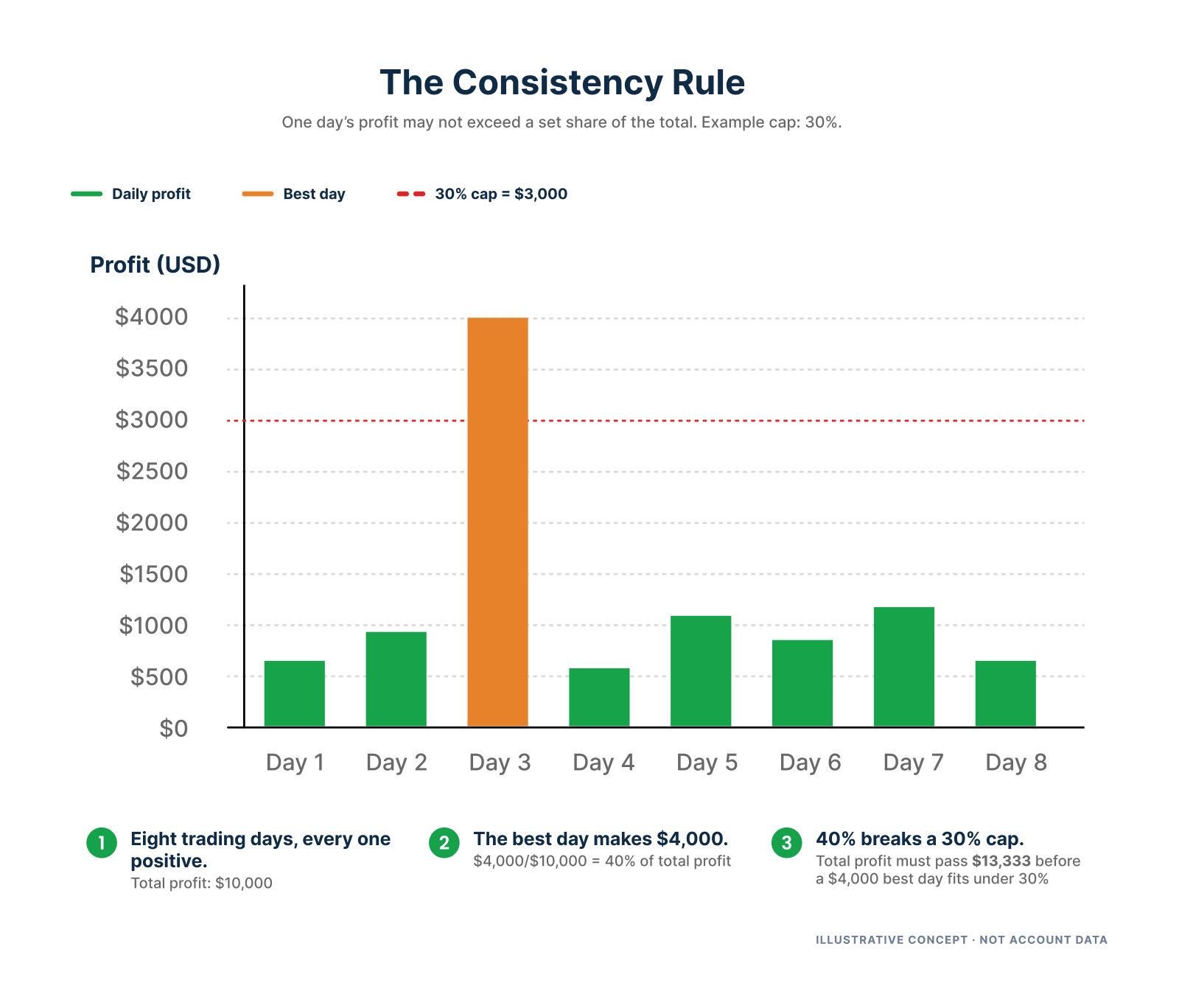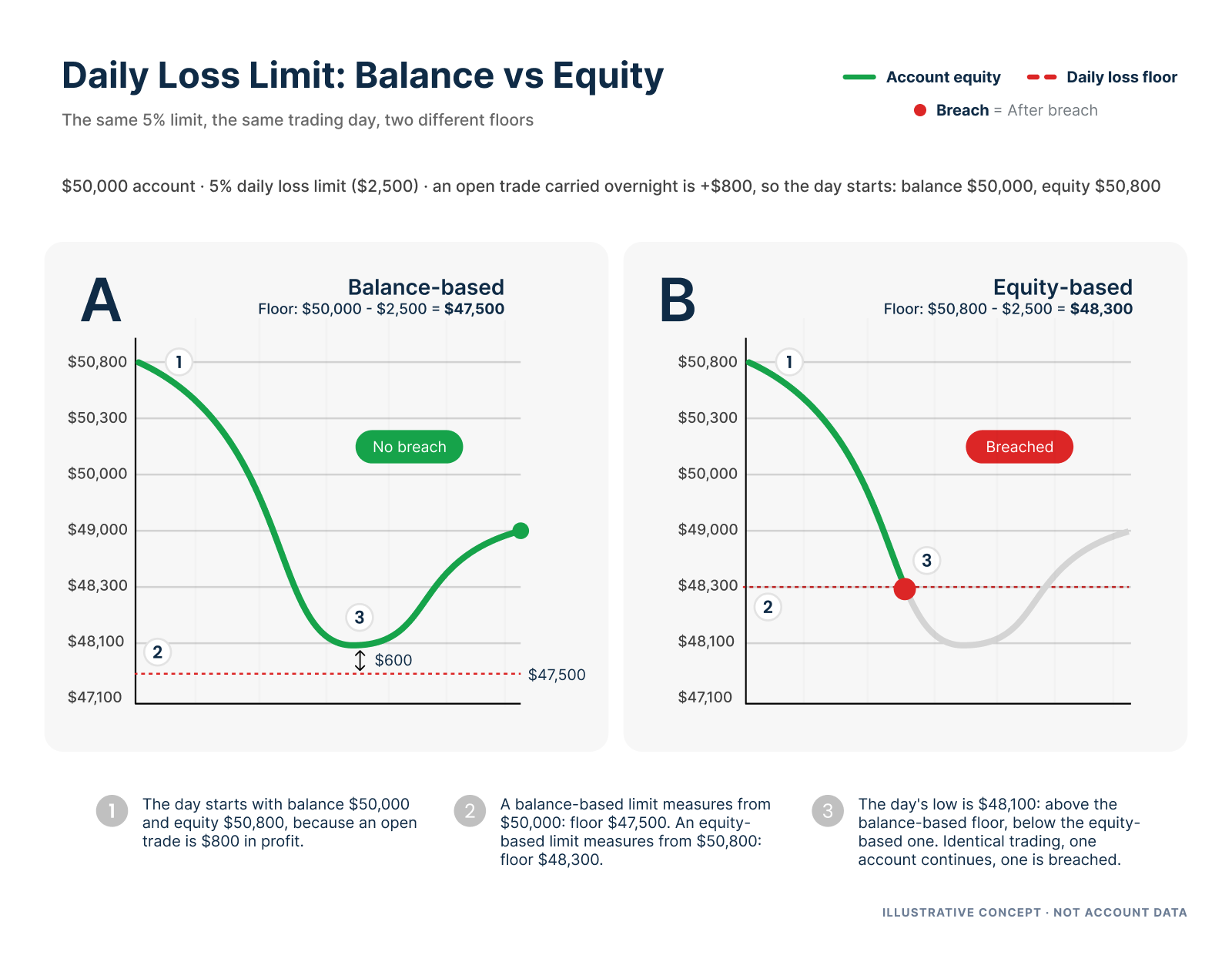

Prop firm drawdown types define how far a funded account can fall before it breaches. Three exist. Static drawdown fixes the breach level at a set amount below the starting balance. End-of-day trailing drawdown raises that level with each day’s closing balance. Intraday trailing drawdown raises it with peak equity, in real time.
Definition
A prop firm drawdown type sets how far an account can fall before it breaches. Static drawdown holds a fixed floor. Trailing drawdown raises the floor as the account grows, either at the day’s close or in real time.
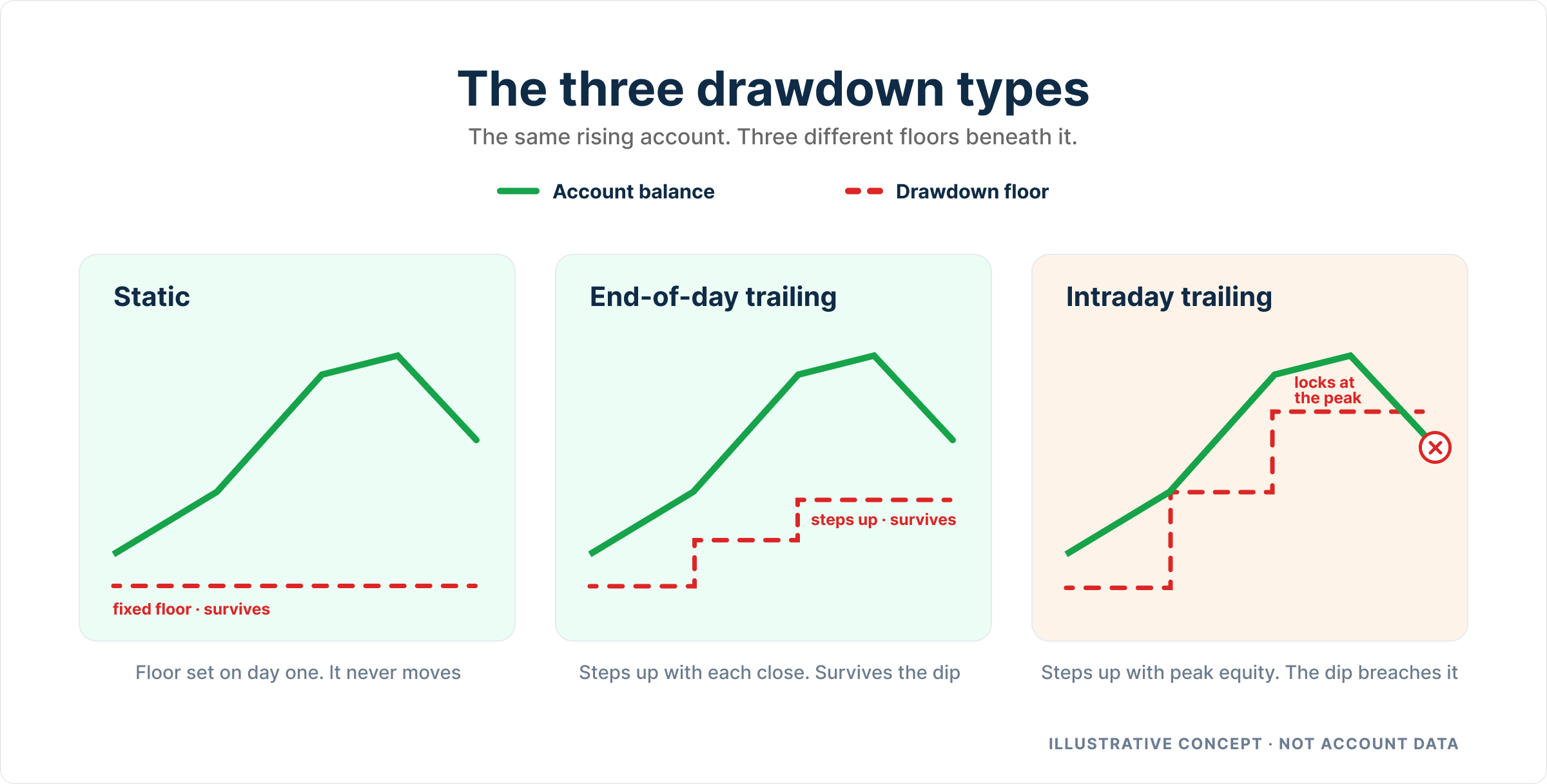
The three types are not variations on a theme. They fail in different ways.
Static drawdown sets one number at the start and never moves it. A $50,000 account with a 10% static drawdown breaches at $45,000, whether the account has since reached $52,000 or $80,000. The floor is known on day one.
End-of-day trailing drawdown recalculates the floor once per session, against that day’s closing balance. Profits you close raise the floor. Profits you give back before the close do not.
Intraday trailing drawdown recalculates the floor continuously, against peak equity. An unrealised profit you never banked still raises the floor. This is the version that surprises traders, and it is covered in full on trailing drawdown explained.
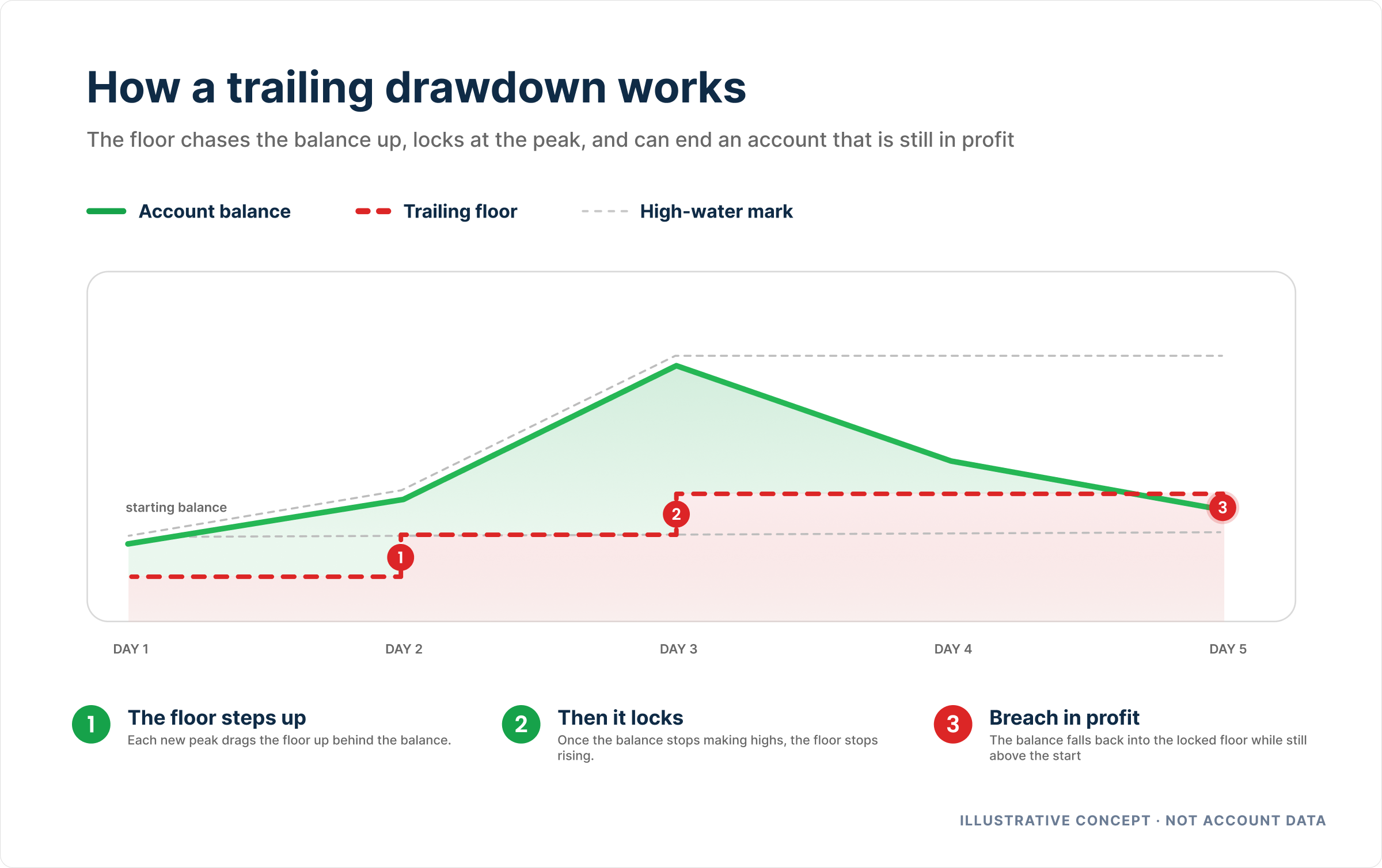
Trailing drawdown of either kind is a ratchet. It moves up and it does not move back down.
How it works (worked example)
One account, one starting balance, three drawdown types. The account trades identically in each column.
Account: $50,000. Drawdown: 10% ($5,000). Starting floor: $45,000.
| Day | Peak equity that day | Closing balance | Static floor | EOD trailing floor | Intraday trailing floor |
|---|---|---|---|---|---|
| 1 | $51,000 | $50,500 | $45,000 | $45,500 | $46,000 |
| 2 | $53,000 | $50,800 | $45,000 | $45,800 | $48,000 |
| 3 | $52,000 | $51,500 | $45,000 | $46,500 | $48,000 |
| 4 | $51,600 | $48,200 | $45,000 | $46,500 | $48,000 |
| 5 | $48,400 | $47,900 | $45,000 | $46,500 | BREACHED |
Read day 2. Equity touched $53,000 intraday and closed at $50,800. The intraday floor jumped to $48,000 on a profit the trader never banked. The end-of-day floor moved to $45,800, against the balance actually closed.
Read day 5. The account closed at $47,900, a little under the $50,000 it started with but still $2,900 clear of the static floor. Static and end-of-day trailing both keep it open. Intraday trailing does not: that floor locked at $48,000 on day 2, and the balance has now dropped through it.
The trader made the same trades in every column. The rule decided the outcome.
How firms differ
Three patterns hold across the firms we cover.
Futures firms lean on trailing drawdown. CFD and forex firms lean on static. Firms offering both models normally pair intraday trailing with no daily loss limit, and end-of-day trailing with one, because the daily cap does the job the intraday trail would otherwise do.
Apex Trader Funding publishes both models and states the trade-off in its own terms: EOD trailing comes with a fixed daily loss limit, and intraday trailing comes with none. Topstep, MyFundedFutures and FTMO each state their model in their published rules.
Every drawdown rule we publish is taken from the firm’s official terms, not its marketing pages, and each firm’s review carries the date it was last checked. Where a firm’s marketing describes the rule differently from its terms, the terms are what your account will be judged against.
Why it matters for passing
The drawdown type decides which trading behaviour breaches an account.
Under static drawdown, only realised losses matter, and the floor is a fixed number. Under end-of-day trailing, closing a day in profit permanently raises the level you must stay above. Under intraday trailing, a position that runs into profit and comes back can breach the account without a single losing day being closed.
Scalpers and traders who let winners run into large unrealised gains are most exposed to intraday trailing. Swing traders who hold overnight are most exposed to end-of-day trailing, because every good close ratchets the floor.
Read the drawdown type before the profit split. A 90% split on an account you cannot keep is worth nothing. Prop firm evaluations covers the rest of what a challenge tests, and how prop firm challenges work covers the structure the drawdown sits inside.
Traders comparing futures firms specifically should start with futures prop firms, because trailing drawdown is close to standard in that category.
Frequently Asked Questions
What is the difference between static and trailing drawdown?
Static drawdown sets a fixed floor below your starting balance and never moves it. Trailing drawdown raises the floor as your account grows, so profits pull the breach level up behind you.
Which drawdown type is best for a beginner?
Static drawdown is the most predictable. The breach level is a single number you can write down on day one, and it does not change no matter how the account performs.
Do all prop firms use the same drawdown type?
No. Futures firms commonly use trailing drawdown. CFD and forex firms more often use static. Some firms offer both and let you choose at checkout.
How do I find out which drawdown type a firm uses?
Read the firm's official terms rather than its sales page. Each firm's review records the drawdown type it uses, with the date it was last checked.
Can a drawdown type change after I buy a challenge?
Firms change their rules. Changes normally apply to new accounts, but check the terms you agreed to, and check whether the firm reserves the right to vary rules on live accounts.