
A prop firm daily loss limit is the maximum an account can lose in one trading day before the challenge or funded account fails. Firms set it as a percentage or dollar figure, usually 3% to 5%, measured against balance or equity. It resets each day, and some firms apply none.
What a daily loss limit is
A daily loss limit is a prop firm rule that caps how much an account may lose in one trading day. Breaching it fails the account. Firms set it as a percentage or dollar figure that resets each day.
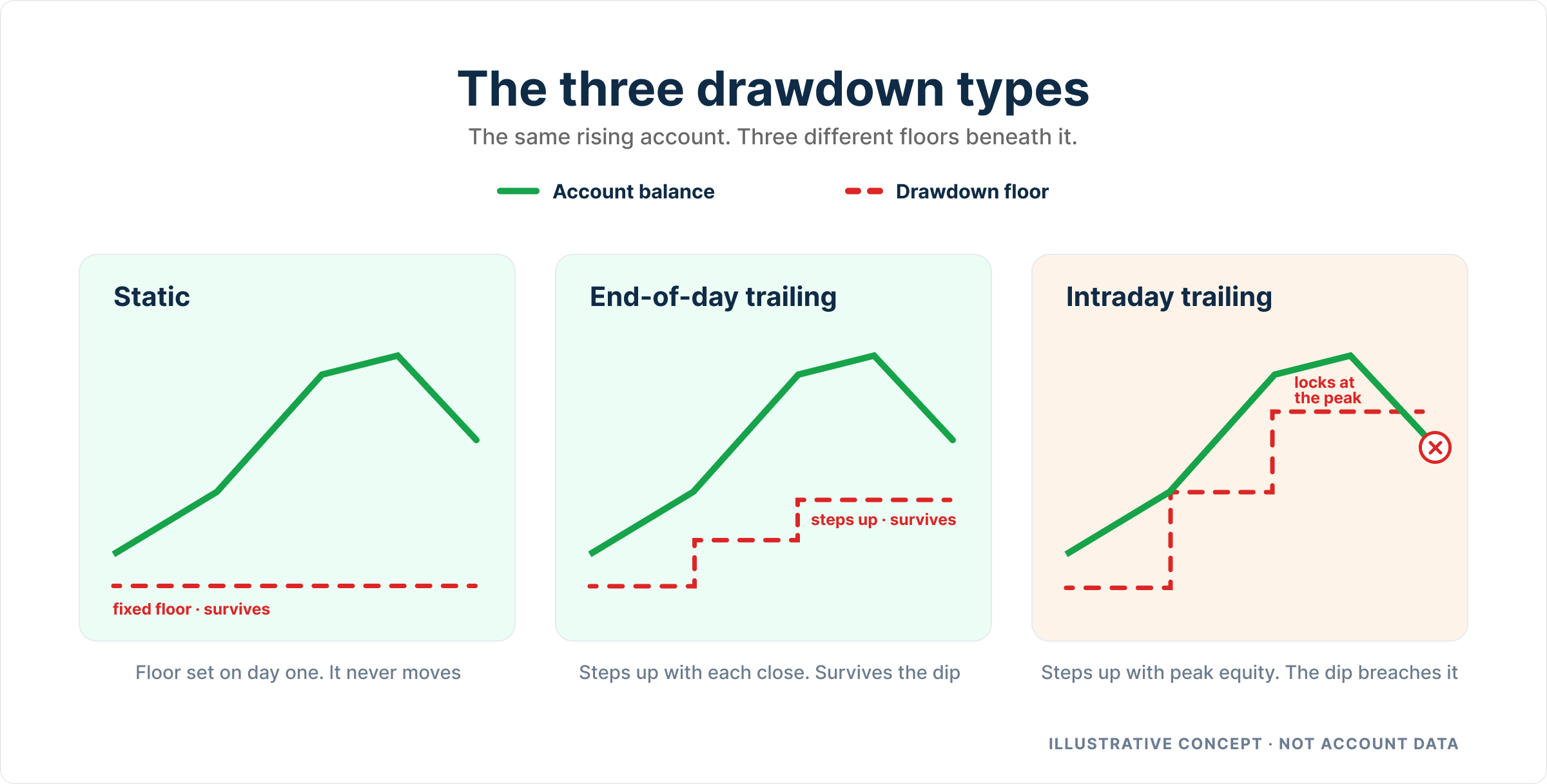
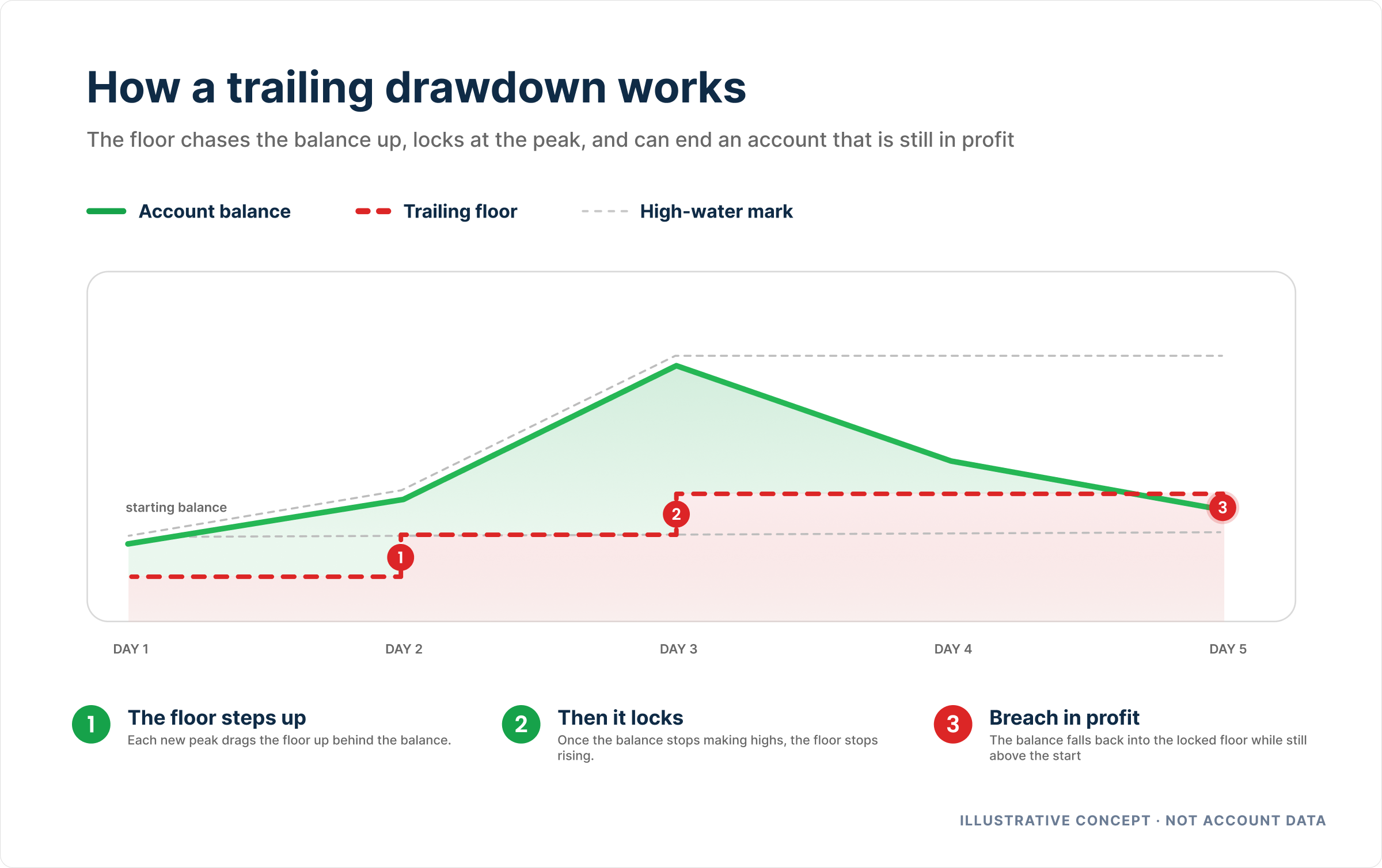
The limit is separate from the maximum overall drawdown, which governs the whole account rather than a single day. Traders also call it the daily drawdown or the max daily loss, and the three terms mean the same rule. Official firm terms define the exact figure and what it is measured against. Most limits sit between 3% and 5%, and some firms replace the daily cap with a trailing drawdown that governs the account continuously.
How the daily loss limit works
The calculation is a subtraction from the day’s starting figure. Multiply the limit by your account, then take it off the start-of-day value:
Start-of-day figure − (limit % × account) = daily floor
Take a 5% limit on a $100,000 account. The daily floor sits at $95,000. If your balance or equity touches $95,000 at any point that day, the account breaches. Book a $3,000 profit early and the floor does not move up; it stays at $95,000 until the day resets.
Futures firms often set the limit in dollars instead. A $2,000 daily loss limit on a $50,000 account works the same way, with the floor at $48,000 for that day.
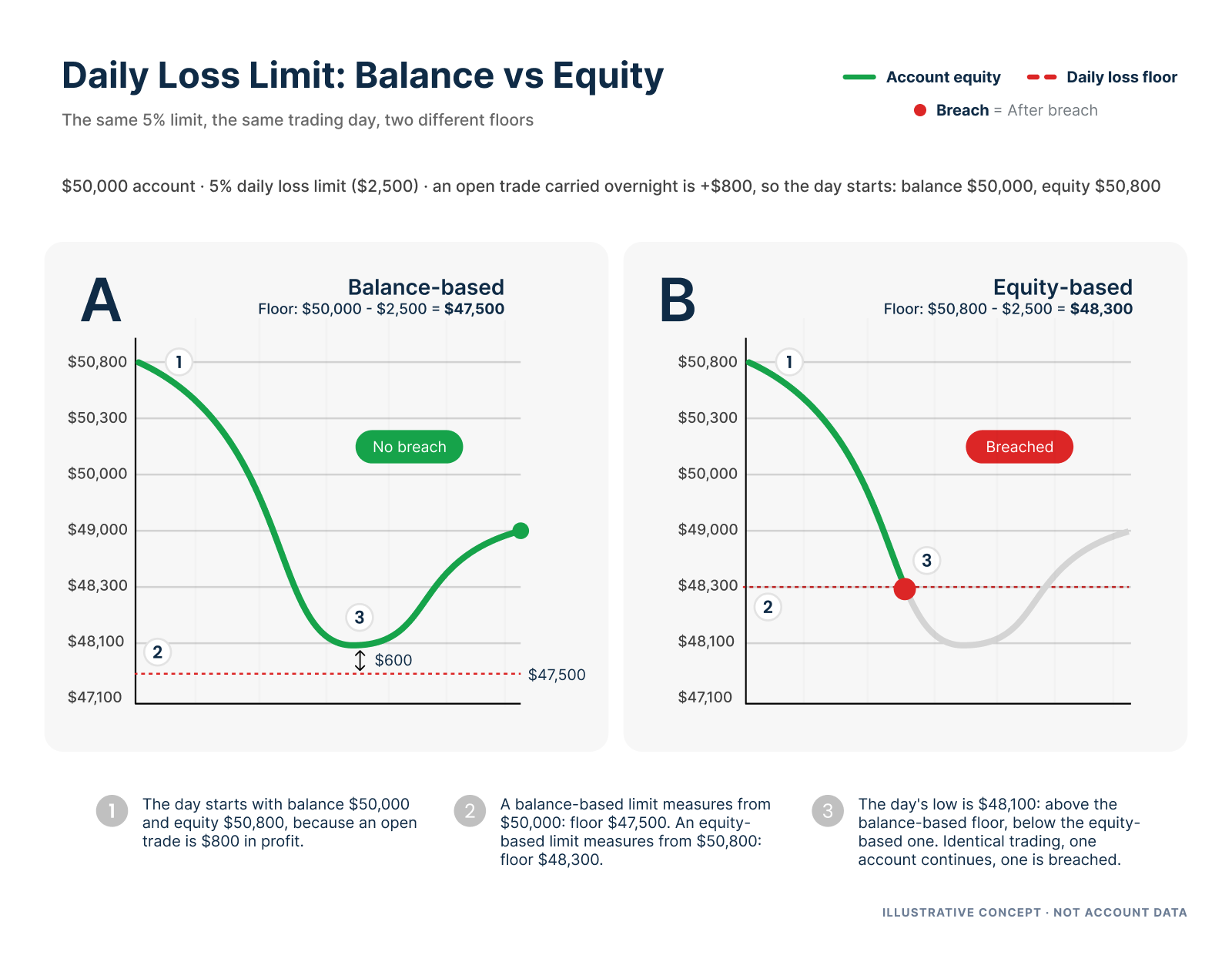
The limit is measured against one of two figures, and this is the detail that varies most between firms. A balance-based limit counts only closed trades, measured from your start-of-day balance, so an open losing position does not breach it until you close. An equity-based limit counts live equity, including floating profit and loss, so an unrealised loss can breach it while the trade is still open. Some firms use whichever of balance or equity is higher at the start of the day. Equity-based and higher-of limits are stricter, because floating losses count in real time. The limit is also checked at different times: an end-of-day limit reads your balance only at the close, while an intraday limit reads live equity throughout the session.
How firms differ
Daily loss limits differ on three things: the size of the limit, the basis it is measured against, and whether a firm sets one at all. Most CFD firms use a 4% to 5% limit, while instant-funding and futures accounts vary more widely. On basis, DNA Funded and FundedNext measure on balance, FTMO and Instant Funding measure on equity, and Maven and Hantec take the higher of the two. A large group, mostly futures firms, sets no daily limit at all and relies on a trailing or end-of-day maximum drawdown instead, including TradeDay, Apex Trader Funding, MyFundedFutures and FundedNext Futures, most of which appear in our best futures prop firms list. Each firm’s review records its daily loss limit, the basis it is measured against, and the date it was last checked.
Why the daily loss limit matters for passing
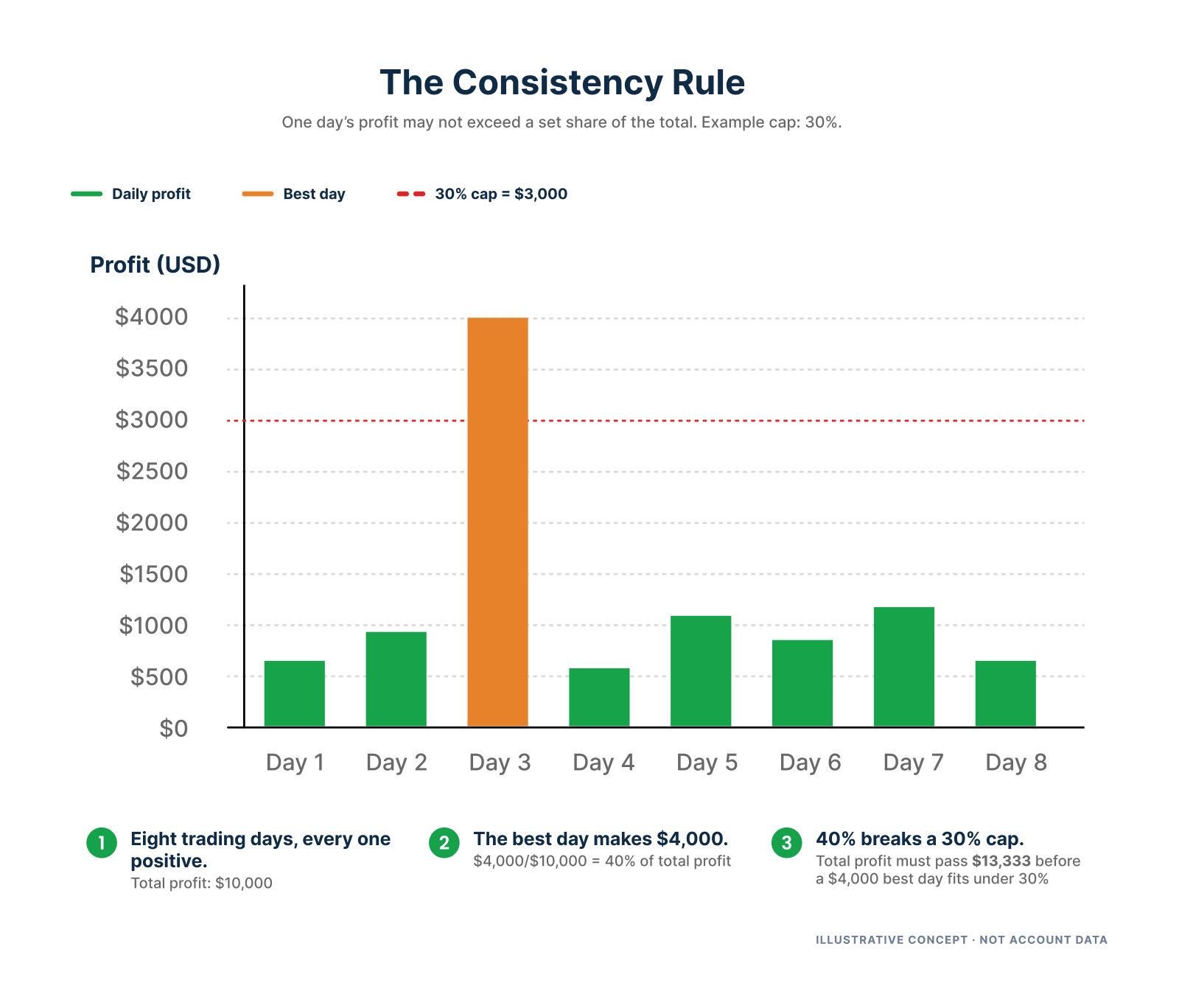
The daily loss limit is the rule that ends most challenges, so it shapes daily risk more than any other condition. Because a single bad day fails the account outright, capping your risk per day well below the limit is the dependable way through. On an equity-based limit, that means watching open positions, not just closed ones. Our guide on how prop firm challenges work covers daily risk sizing in more detail, and the daily limit works alongside a firm’s maximum drawdown and its consistency rule.
Frequently Asked Questions
What is a daily loss limit in prop firms?
A daily loss limit is the most an account may lose in one trading day before it fails. Firms set it as a percentage or dollar figure, usually 3% to 5%, resetting each day.
Which prop firms have no daily loss limit?
Many futures firms use only a trailing or end-of-day drawdown and set no separate daily loss limit, including TradeDay, MyFundedFutures, Apex and FundedNext Futures. Some CFD accounts drop it too.
Is the daily loss limit based on balance or equity?
It depends on the firm. Some measure it on start-of-day balance, some on live equity including open trades, and some on the higher of the two. Equity-based limits are stricter because floating losses count.
How is the daily loss limit calculated?
Multiply the percentage by your account, then subtract from the day's starting figure. A 5% limit on $100,000 sets the floor at $95,000. Touch it during the day and the account breaches. The floor resets each morning.
What is the difference between an end-of-day and an intraday daily loss limit?
An end-of-day limit checks your balance only at the daily close, so intraday dips are allowed. An intraday limit checks live equity all session, so a floating loss can breach it before you close the trade.
What happens if you hit the daily loss limit?
Hitting it usually fails the account immediately, unlike a consistency breach, which only delays a payout. Most firms close open positions and end the account. A few offer a paid reset to try again.