
A prop firm consistency rule limits how much of your total profit can come from a single trading day, usually between 15% and 50% of the cumulative total. Breaching it normally delays a payout rather than failing the account. A growing number of firms apply no consistency rule at all.
What a consistency rule is
A consistency rule requires that no single trading day’s profit exceeds a set share of your total profit, most often 15% to 50%. It stops traders passing an evaluation on one lucky, oversized trade instead of steady performance.
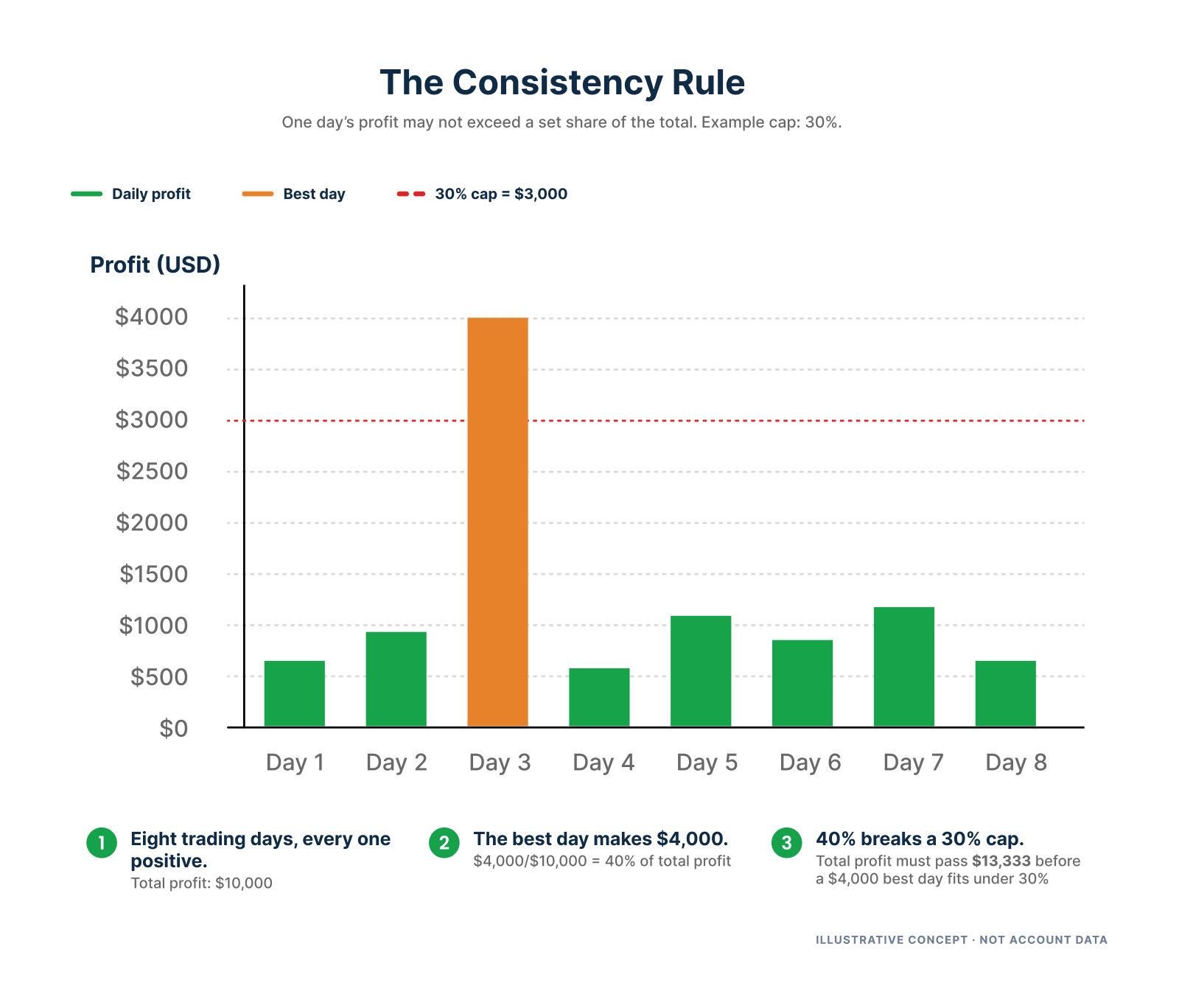
Firms measure the rule against cumulative profit, not account size. The limit is a percentage, and the lower the percentage, the more evenly profit must be spread. Official firm terms define the exact figure, and it often differs between a firm’s evaluation and funded stages. Some firms replace the best-day cap with a minimum-profitable-days requirement or a per-position cap, and some apply no rule at all. The rule sits alongside a firm’s other pass and fail conditions, such as drawdown types and the daily loss limit.
How the consistency rule works
The calculation is simple. Divide your best single day’s profit by your total profit, then multiply by 100:
Best day profit ÷ total profit × 100 ≤ consistency limit
Take a 40% rule and $3,000 in total profit. Your best single day cannot exceed $1,200, because $1,200 is 40% of $3,000. If your best day reached $1,500, you would keep trading until total profit hit $3,750, the point where $1,500 becomes 40% of the total.
A strict 15% rule tightens this sharply. On the same $3,000 profit, your best day cannot exceed $450. Instant-funding accounts commonly use this lower figure.
How firms differ
Consistency rules differ on three things: the type of rule, the size of the cap, and whether a firm sets one at all. Best-day caps are the most common, set anywhere from 15% to 50% of total profit. A 15% cap is typical of instant-funding accounts such as Instant Funding’s IF1, 40% is the most common funded figure and is used by FundedNext and Instant Funding, and Topstep sets its cap at 50% of the profit target rather than of total profit. A smaller group uses a per-position cap instead, such as Trade the Pool’s 30% maximum per position, and others require a set number of profitable days, as The5ers does. A large group applies no rule at all, including FTMO, City Traders Imperium, FundedNext’s Stellar accounts, Think Capital and Blueberry Funded. Each firm’s review records the consistency rule it applies and the date that value was last checked.
Why the consistency rule matters for passing
The consistency rule shapes how you size trades across a whole challenge, not just whether you pass. Because it measures your best day against your total, a single oversized win forces you to keep trading to dilute it, which delays funding and payouts. Spreading risk evenly across several days is the dependable way through. Our guide on how prop firm challenges work covers position sizing against the rule in more detail.
Frequently Asked Questions
What is a consistency rule in prop firms?
A consistency rule caps how much of your total profit can come from one trading day, commonly 15% to 50%. It stops traders passing a challenge on a single oversized trade and keeps profit spread across multiple days.
Which prop firms have no consistency rule?
Several firms apply none, including FTMO, FundedNext Stellar, City Traders Imperium, Think Capital and Blueberry Funded. Many evaluation and flex accounts drop it while the funded stage keeps it.
How is the consistency rule calculated?
Divide your best single day's profit by your total profit, then multiply by 100. The result must stay at or below the firm's limit. On a 40% rule with $3,000 profit, your best day cannot exceed $1,200.
What does a 20%, 30% or 40% consistency rule mean?
The percentage is the most your best day may contribute to total profit. Lower is stricter. On $5,000 profit, a 20% rule caps the best day at $1,000, a 30% rule at $1,500, and a 40% rule at $2,000.
What happens if you break the consistency rule?
Breaking it rarely fails the account outright, unlike a drawdown breach. Usually the firm delays your payout. You keep trading until total profit grows enough that the outsized day falls back within the allowed percentage.
Does the consistency rule apply during the challenge or only when funded?
It varies by firm. Some enforce it throughout, some only on funded accounts, and some only at payout. Maven and FundedNext apply it on the funded stage. Always check the firm's own terms.