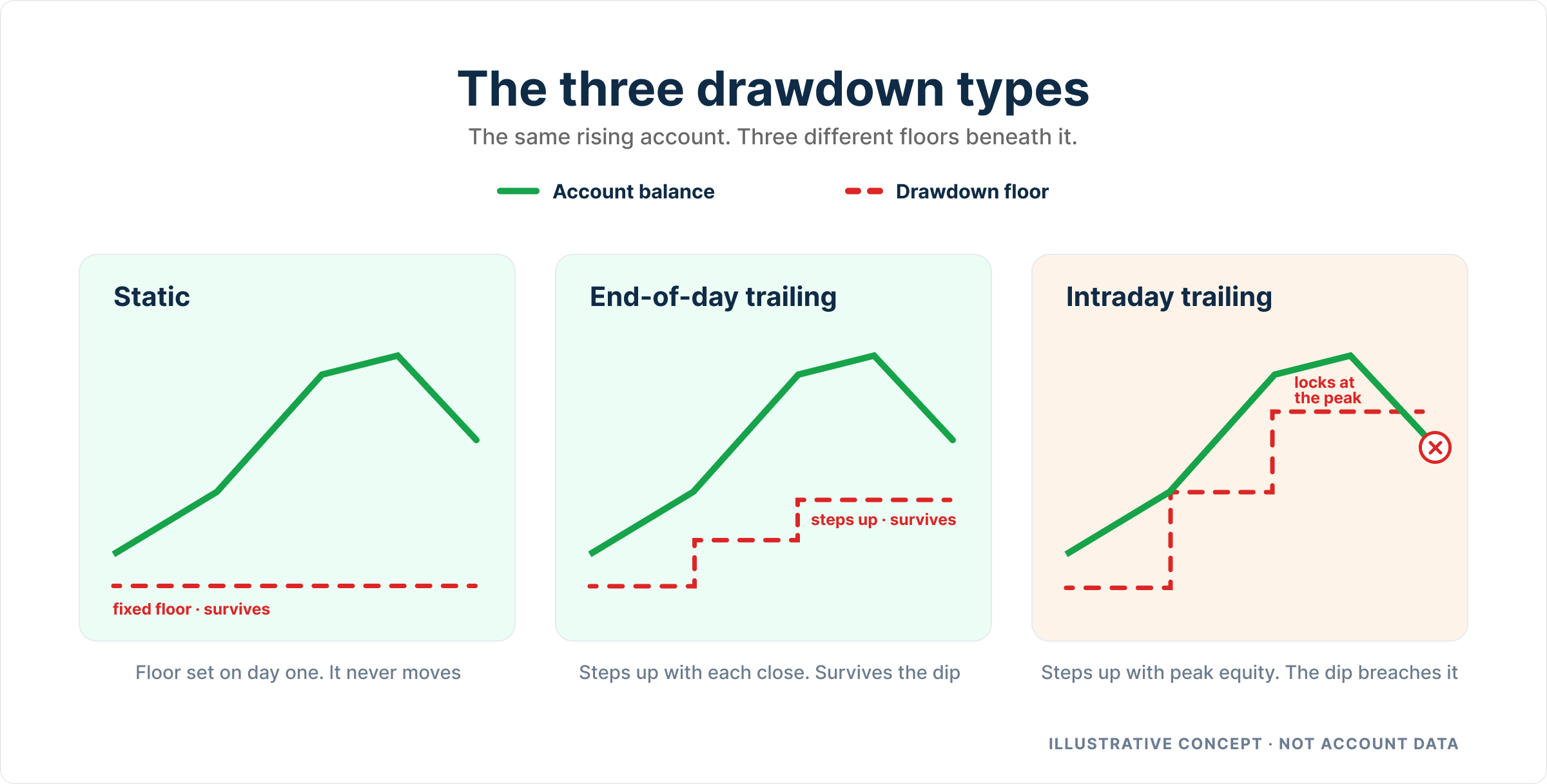

Trailing drawdown is a loss limit that follows an account’s high-water mark upward. As the account climbs, the breach level climbs with it, and it never moves back down. Two versions exist. End-of-day trailing updates at the session close. Intraday trailing updates continuously, on peak equity rather than closed balance.
Definition
Trailing drawdown is a breach level that rises with an account’s high-water mark and never falls back. End-of-day trailing updates once, at the session close. Intraday trailing updates continuously, tracking peak equity rather than closed balance.
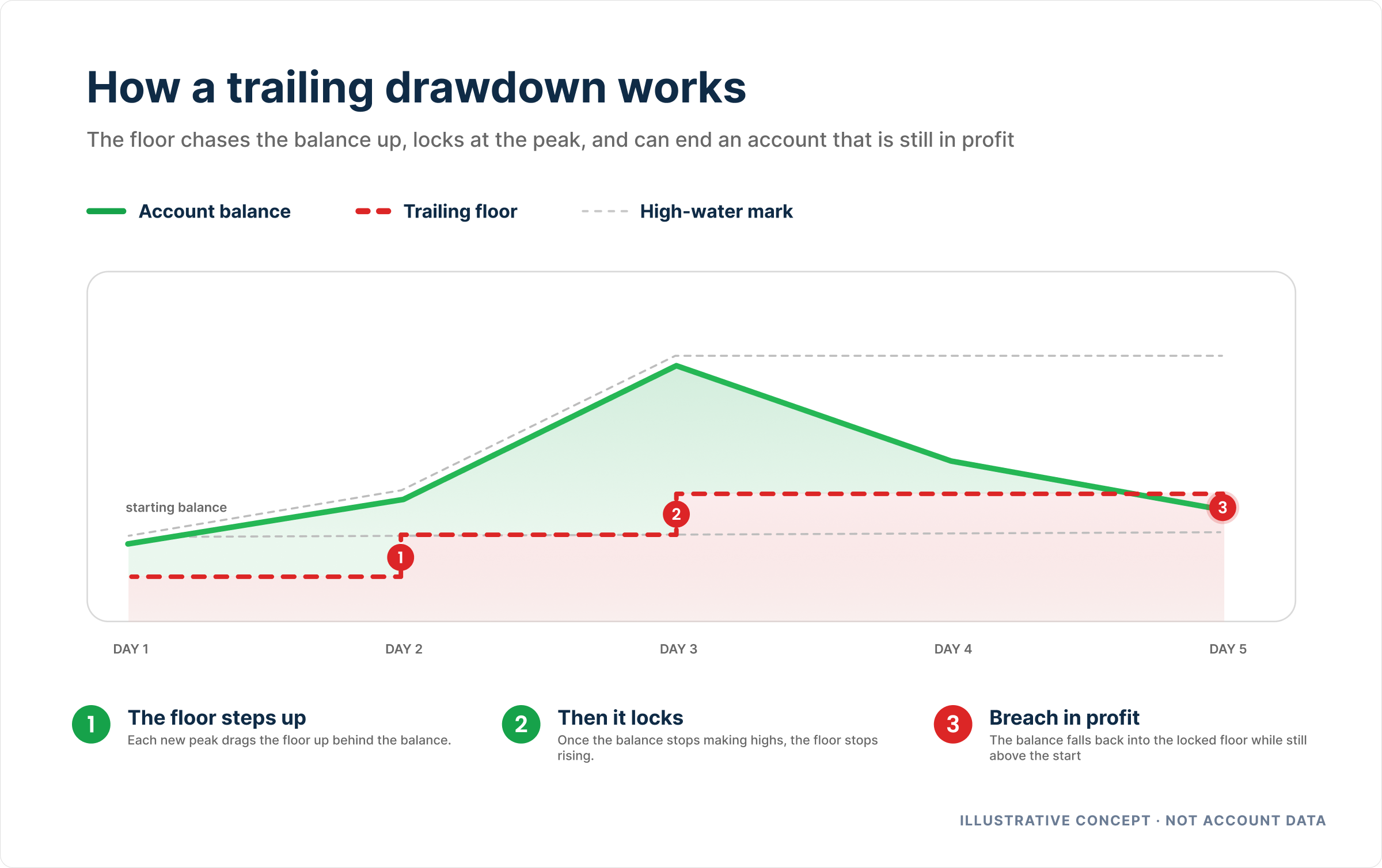
Three properties define it.
It ratchets. The floor moves up with the account and never moves down. A good week permanently raises the level you must stay above.
It measures against a high-water mark, not your starting balance. Once the account has been at $54,000, the firm’s calculation uses $54,000, whatever the account is worth now.
It can breach an account that is still profitable. This follows from the first two. If your floor has ratcheted to $50,500 on a $50,000 account, a fall to $50,300 breaches you, even though the account is still $300 above where it started.
The rule exists to protect the firm’s capital, not to test your trading. Understanding that makes its behaviour predictable rather than arbitrary.
How it works (worked example)
Account: $50,000. Trailing drawdown: $2,500. Starting floor: $47,500.
The floor is always the high-water mark minus $2,500.
| Day | Peak equity | Closing balance | High-water mark | Floor after today | Room left |
|---|---|---|---|---|---|
| 1 | $50,900 | $50,600 | $50,900 | $48,400 | $2,200 |
| 2 | $52,400 | $51,100 | $52,400 | $49,900 | $1,200 |
| 3 | $53,000 | $52,700 | $53,000 | $50,500 | $2,200 |
| 4 | $52,800 | $50,900 | $53,000 | $50,500 | $400 |
| 5 | $50,300 | $50,300 | $53,000 | $50,500 | BREACHED |
Day 5 is the point of the example. The account closes at $50,300. That is $300 above the starting balance. The trader has not lost money. The account is breached anyway, because the floor ratcheted to $50,500 on day 3 and never came back down.
Note day 2 and day 4. Peak equity rose above the closing balance both days. Under intraday trailing, the floor is set by the peak ($52,400 on day 2), so unrealised profit the trader never banked still moved the floor. Under end-of-day trailing, the floor is set by the close ($51,100 on day 2), and the intraday spike is ignored.
Same account, same trades. The intraday floor sits higher the whole way through, so the intraday account breaches on day 5 while an end-of-day account, tracking the lower closes, survives that day.
When the trail stops
Trailing drawdown does not usually trail forever. The worked example above was the exception, a trail that never stopped, which is why the floor climbed past the $50,000 starting balance to $50,500 and breached the account while it was still in profit.
Many firms cap it. At those firms the floor stops rising once it reaches the starting balance, sometimes plus a small buffer. On a $50,000 account with a $2,500 trail, the floor climbs from $47,500 and locks at $50,000 once the account has reached $52,500. After that the floor is fixed, the account behaves like a static-drawdown account, and it can no longer be breached in profit.
This is the single most important number in the rule, and firms describe it inconsistently. Some state it plainly in their terms. Some state it only in a help-centre article. Some do not state it at all, which is itself worth knowing before you pay. Each firm’s own terms are the place to check where its trail locks, and we record that value on every firm’s review.
How firms differ
Apex Trader Funding publishes both models and pairs them deliberately. Its terms state that end-of-day trailing carries a fixed daily loss limit, and intraday trailing carries none. The logic is that the daily cap and the intraday trail do the same job, so a firm applies one or the other.
That pairing is the pattern to look for. A firm running intraday trailing and a daily loss limit is applying two overlapping constraints, and the account has less room than either rule suggests on its own.
The drawdown rules we publish come from each firm’s official terms rather than its marketing pages, and each firm’s review carries the date it was last checked. Where the two disagree, the terms decide what happens to your account.
Why it matters for passing
Trailing drawdown changes which trades are safe, not just how many losses you can take.
Letting a winner run creates a new high-water mark. Under intraday trailing, that mark is set the moment the trade is in profit, whether or not you close it there. Giving back an unrealised gain therefore costs you twice: once in the trade, once in the floor.
Three practical consequences.
Scalpers building profit in small increments are relatively safe, because the high-water mark rises in small steps. Traders who hold for large moves are most exposed, because a single spike can move the floor a long way. Taking partial profits raises the floor under end-of-day trailing but banks the gain, which is the trade-off the rule is built around.
Passing the evaluation is a separate problem from surviving the funded account, and trailing drawdown is usually harsher on the funded side. Prop firm evaluations covers what the challenge tests. How prop firm challenges work covers the structure the drawdown sits inside. For the full comparison against static drawdown, see prop firm drawdown types.
Trailing drawdown is close to standard among futures prop firms, so traders comparing that category should read the trail-stop rule before the price.
Frequently Asked Questions
Does trailing drawdown reset daily?
No. Trailing drawdown does not reset. It ratchets upward with your account's high-water mark and never falls back. A daily loss limit resets each day, which is a separate rule.
Is trailing drawdown good or bad?
It is stricter than static drawdown. It protects the firm by locking in your gains as a floor you must stay above, and it can breach an account that is still in profit.
Does trailing drawdown stop at some point?
At many firms, yes. The trail commonly stops once the floor reaches the starting balance, sometimes plus a small buffer. After that the floor is fixed. Check the firm's terms.
Can trailing drawdown breach an account that is in profit?
Yes, and this is its defining feature. If the floor has ratcheted above your starting balance, a pullback can breach you while the account is still worth more than you started with.
What is the difference between end-of-day and intraday trailing drawdown?
End-of-day trailing updates once, against the day's closing balance. Intraday trailing updates continuously, against peak equity, so unrealised profit you never banked still raises the floor.
Which is stricter, trailing drawdown or a daily loss limit?
They do different jobs. A daily loss limit caps one day and resets. Trailing drawdown caps the account's lifetime and never resets. Many firms apply one or the other, not both.